


Location & Transportation
Catawba County gives manufacturers and distribution companies a strategic logistics advantage in the heart of the Southeast. Interstate 40 runs directly through the county, with immediate access to US-321 and NC-16 and quick connections to I-77 and I-85—creating efficient, multi-directional routing for inbound raw materials and outbound finished goods. From this central location, roughly 60% of the U.S. population can be reached within a one-day drive, helping companies reduce transit times, control freight costs, and consistently meet customer delivery windows across the Southeast, Mid-Atlantic, and Midwest.
For global and multimodal supply chains, Catawba County delivers exceptional connectivity. Charlotte Douglas International Airport—less than an hour away—provides extensive domestic and international passenger and air cargo service, while Hickory Regional Airport supports corporate aviation, on-demand business travel, and aerospace-related operations. Norfolk Southern rail service offers freight capacity for bulk, industrial, and intermodal shipments. Companies also benefit from efficient access to multiple deepwater ports, including the Port of Wilmington and Port of Morehead City in North Carolina, as well as the Port of Charleston in South Carolina. The Charlotte Inland Port further strengthens these advantages by linking ocean ports to the region through intermodal rail, reducing transportation costs and improving container flow. The result is a resilient, scalable logistics platform that supports just-in-time manufacturing and growing distribution operations from a cost-competitive North Carolina base.

60%
of the U.S. population
within 1 day's drive


Charlotte Douglas International Airport
Charlotte Douglas International Airport (CLT) is the world’s 6th busiest airport, serving over 53 million passengers annually and generating roughly $40 billion in economic impact for North Carolina. As a major hub for American Airlines, it offers nonstop service to 193 destinations, providing exceptional domestic and international connectivity—an important advantage for corporate headquarters, advanced manufacturing, and logistics operations. With over 5,500 acres, direct access to I-85 and I-77, and a multibillion-dollar capital expansion program, Destination CLT, focused on long-term capacity and modernization, CLT represents a highly strategic asset supporting strong business travel access and supply chain efficiency.
193
nonstop
destinations
6th
busiest airport
in the world
53 million
passengers
annually
1,800
daily
arrivals & departures
43
international
destinations


Daily nonstop service to international destinations including
Frankfurt, London, Madrid, Mexico City, Montreal, Munich, Paris, Rome, and Toronto, and more.

Hickory Regional Airport
The Hickory Regional Airport offers a rare opportunity to develop an integrated aerospace and aviation manufacturing campus anchored by more than 1,000 acres of city-owned land. This level of public control allows for strategic master planning, industrial sites, airside-access parcels, and long-term expansion capacity—all within an uncongested aviation environment. Companies benefit from lower operating costs than major metro airports while maintaining proximity to the greater Charlotte region and its global connectivity.
Directly adjacent to the airfield, Catawba Valley Community College's Dale Earnhardt Regional Workforce Complex provides a purpose-built pipeline for aviation and advanced manufacturing talent, including programs in machining, mechatronics, avionics, and technical trades. Just minutes away, the planned Hickory Innovation District is designed to be a mixed-use hub for technology, entrepreneurship, higher education partnerships, and creative office space intended to foster collaboration between industry, students, and startups. Together, the Hickory Regional Airport, the Dale Earnhardt Regional Workforce Complex, and the Hickory Innovation District create a connected ecosystem where companies can recruit talent, conduct R&D, manufacture, test, and scale operations in one coordinated environment.
739
total acres
12,000
s.f. group hangar
12
new T-Hangars
6,400' x 1500'
asphalt runway 6/24

Port of Wilmington, NC
The Port of Wilmington (NC) is a deepwater Atlantic gateway with a 42-foot channel, nine berths, and four post-Panamax plus three neo-Panamax container cranes, enabling it to efficiently handle large container ships and diverse cargoes including bulk, breakbulk, reefer, and Ro-Ro freight. It combines modern cargo handling infrastructure with extensive storage—one million square feet of covered space—and best-in-class vessel productivity that has ranked it among the top container terminals in North America for efficiency. Catawba County's targeted recruitment of life sciences companies is reinforced by Frontier Scientific Solutions Wilmington International Airport facility. Currently under construction, it is slated to be America's largest GMP temperature controlled logistics hub, purpose-built to serve the pharmaceutical and biopharmaceutical industries with unmatched speed, security, and efficiency. The port’s direct intermodal connections via CSX rail and proximity to major highways (including I-40 and I-95) support fast inland distribution, while lower congestion and strong landside access help shippers move cargo quickly to key Southeast and Midwest markets. Wilmington also offers Foreign Trade Zone status and C-TPAT certification, enhancing cost and security advantages for global manufacturers and distributors.
42 ft.
channel depth
M.L.L.W.
330,000+
TEUs in 2025
9
berths
284
total acres
1 million
square feet of
covered storage
125
acres of
open storage area

Port of Morehead City, NC
The Port of Morehead City (NC) is a strategically important deepwater maritime facility just four miles from the Atlantic Ocean, with a 45-foot channel and nine berths that support bulk, breakbulk, roll-on/roll-off, and general cargo operations. Its location within ~700 miles of more than 70% of the U.S. industrial base and direct rail service via Norfolk Southern make it an efficient gateway for importing and exporting heavy commodities like fertilizer, grain, lumber, metal products, rubber, and other industrial materials, supported by over one million square feet of covered and open storage and ongoing warehouse expansion. The port’s deepwater access, multipurpose cargo handling equipment, and robust highway and rail connectivity position it as a reliable choice for manufacturers and global shippers handling complex or oversized shipments and bulk freight in international and regional supply chains.
45 ft.
channel depth
M.L.L.W.
2.3M+
tons of cargo handled annually
9
berths
128
total acres
1M+
square feet of
covered storage
43
acres of
open storage area

Charlotte Inland Port
The Charlotte Inland Port strengthens Catawba County's position in the global marketplace by bringing deepwater port access closer to manufacturers and distributors. Through direct CSX intermodal rail service linking to the Port of Wilmington, containers move efficiently between the coast and the Charlotte region with next-day service, reducing transit times and minimizing congestion risk.
For manufacturers, the Charlotte Inland Port delivers meaningful cost and operational advantages. By shifting long-haul container moves from truck to rail, companies can lower freight expenses, improve equipment availability, and enhance supply chain reliability. With ongoing rail investments and scalable intermodal capacity, the inland port offers a resilient, cost-competitive platform for global trade.
1 day
transit service between
Wilmington & Charlotte
20
total acres
2,000
grounded/wheeled
container capacity
Port of Charleston, SC
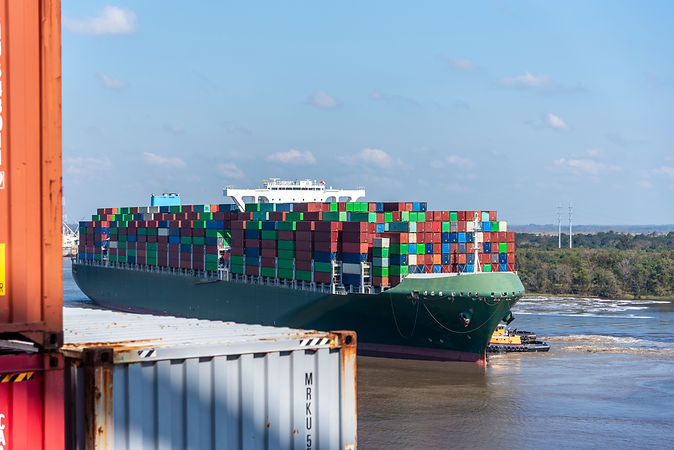
The Port of Charleston (SC) is a major, high-capacity global trade hub featuring the deepest harbor on the U.S. East Coast at 52 ft, enabling fully loaded mega container vessels—including ships above 15,000 TEU—to call with minimal draft restrictions. It comprises multiple specialized terminals, such as Wando Welch (large container operations with numerous post-Panamax/neo-Panamax ship-to-shore cranes and expansive container yards including reefer capacity) and Hugh K. Leatherman Terminal, which is being expanded with additional berths and electric rail-mounted gantry cranes (RMGs) to handle up to 1 million rail lifts per year and separate intermodal traffic flows for greater efficiency. The port’s rail and intermodal connectivity is being strengthened through near-dock facilities that link directly to CSX and Norfolk Southern networks, improving cargo velocity into inland markets and reducing highway congestion. Additional assets include breakbulk and Ro-Ro terminals, extensive on-dock storage and warehousing, and strategic infrastructure investments such as expanded wharves for more ship-to-shore cranes—positioning Charleston as a scalable, efficient choice for containerized, project, and bulk cargo moving in and out of global supply chains.
52 ft.
channel depth
M.L.L.W.
2.6M+
TEUs in 2025
23
total berths
1,500+
total
acres
6
major terminals
1M+
square feet of
covered storage

Norfolk Southern Railroad
Norfolk Southern (NS) is a major Class I freight railroad operating about 19,400 route miles across 22 states, connecting more than half of the U.S. population and industrial base to key markets and ports. This broad network provides manufacturers with reliable, cost-effective rail access for raw materials and finished goods across the Midwest, Southeast, and Northeast, reducing long-haul trucking costs and improving supply chain efficiency. In North Carolina, NS operates approximately 1,400+ miles of track, linking Charlotte and the Piedmont to major domestic markets.
For global manufacturers, NS connects directly to coastal and inland intermodal hubs, supporting seamless access to export gateways and container terminals. The Norfolk Southern Charlotte Terminal serves as a critical freight and intermodal hub, strengthening logistics options throughout the Carolinas.
Through its REDI Sites program—developed with the Site Selectors Guild—NS certifies rail-served industrial properties for development readiness. Catawba County’s Claremont International Rail Park is one of only 18 REDI Sites nationwide and one of only 7 in the country to achieve Gold Status, underscoring its competitive advantage for rail-served manufacturing projects.
1,121
miles of track in North Carolina
19,400+
miles of track
across 22 states
44
intermodal terminals
50
port partners
7M
car loads delivered annually